For a Deadly Orphan Disease, a UIC Lab plays a key role in future of Gene Therapy
Until recently, families of infants diagnosed with Krabbe disease had few options. The neurological condition, also known as globoid cell leukodystrophy, usually strikes children in their first months of life, and is fatal in 90 percent of cases. Bone marrow stem cell transplants can slow progression but don’t cure the disease.
But the emerging medical approach of gene therapy shows promise for treating Krabbe disease. By using a customized virus to restore the defective gene that causes the condition, scientists hope to rescue patients from its severe effects. A clinical trial is currently underway based on research done by several laboratories, including the group of Ernesto R. Bongarzone, PhD, Professor in the Department of Anatomy and Cell Biology at the University of Illinois College of Medicine.
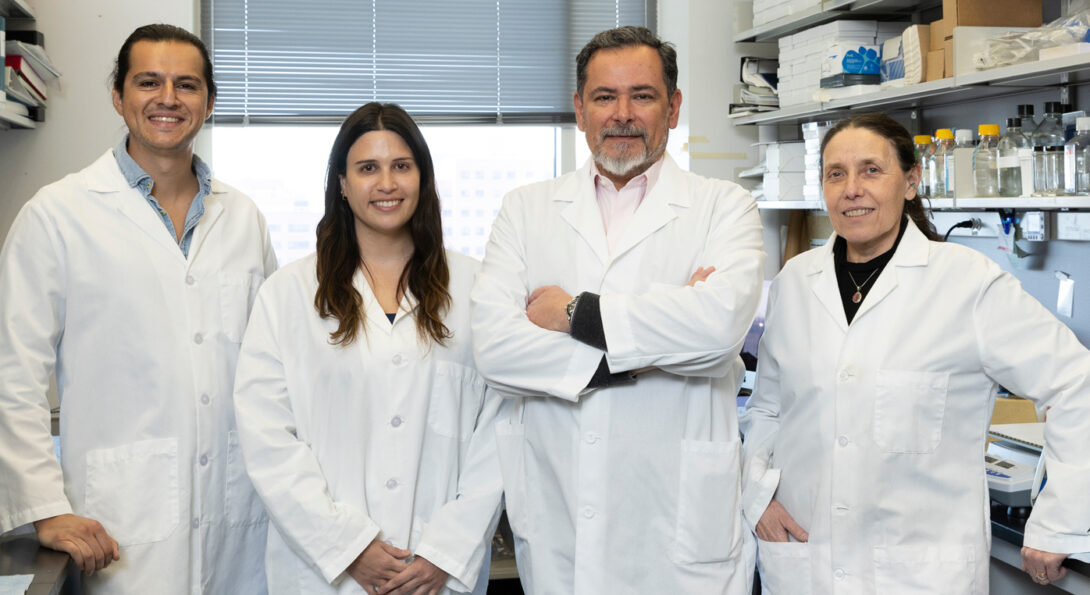
While the Krabbe disease community hopefully awaits the results of these pivotal trials, the Dr. Bongarzone group will use a new group of grants from the Rosenau Family Research Foundation to explore gene therapy’s long-term effects as well as the earliest stages of the disease. A total of $870,000 granted by the Foundation will support four projects awarded to Dr. Bongarzone, Maria Irene Givogri, PhD, Natalia Saldivia Soto, PhD, and Diego Zelada Varas, PhD, from the Department of Anatomy and Cell Biology at the College of Medicine to expand their pursuit to treat and understand this neurological condition.
Dr. Saldivia and Dr. Zelada, both postdoctoral researchers in the Dr. Bongarzone lab, are the first recipients of the New Investigator Grants awarded by the Rosenau Family Research Foundation.
A new phase of research for Krabbe disease Heading link
Krabbe disease is caused by a toxic buildup of a lipid known as psychosine in the brain and nerves accompanied by a loss of myelin – the membrane coating along nerve fibers that inspires the term “white matter.” Scientists traced its origin to a single gene, called GALC, that normally produces an enzyme involved in clearance of psychosine.
Restoring the activity of GALC in an animal model of the disease prevents most of the neurological damage – the result that led to the ongoing gene therapy clinical trial. However, subsequent studies have found that the some of the neuropathology reappears in animals several months after a successful initial treatment. In humans, that still would equate to many years of benefits before relapse, but extending the effects of treatment may be possible if the causes of this relapse are better understood.
“We want to know what triggers this decrease in the efficacy of gene therapy, when it begins, and if there are some brain regions more affected than others,” Dr. Saldivia said. “We want to then use these findings to help improve therapies for an effective, safer and long-lasting treatment of patients.”
One hypothesis is that the reappearance of neurological damage results from an innocuous cause: motor learning. As some areas of the brain forms new neurons and glial cells during the normal course of learning, the benefits of an early neonatal gene therapy may not pass down to the new cells, causing lipid toxicity and demyelination to resume.
So the researchers will place gene therapy-treated animals in an enriched learning environment and closely monitor their brains. The results may translate to what happens to patients treated for Krabbe disease as they go through normal childhood experiences.
“Based on the positive results from many preclinical studies, we would expect that these children will be performing very well for a significant number of years, and that these children will be now exposed to the normal physical activities that every healthy child does, such as learning to play sports or chess or a musical instrument,” Dr. Bongarzone said. “So now our question goes to how the therapy will withstand the stress of these new experiences.”
Other projects funded by the grant will focus on the early stages of Krabbe disease. Dr. Givogri, a Research Associate Professor, will examine the role of the inflammatory system in triggering or amplifying cellular mechanisms involved in the pathophysiology of Krabbe disease, while Dr. Zelada will study whether the damage to neurons and their connections precedes or follows the loss of myelin that classically characterized the disease.
Understanding these mechanisms could help design short-term therapies that protect an infant’s brain before longer-term treatment can begin.
“In the small window of time after the child is diagnosed but before you can begin stem cell or gene therapy, we may be able to protect the central nervous system from the accumulation of these toxic lipids that are so harmful for the brain,” Dr. Givogri said.
Seeing the impact of the science on Krabbe disease patients Heading link
The grants are the latest chapter in a long association between the Rosenau Family Research Foundation and Dr. Bongarzone’s research group, which also studies the loss of myelination in brain diseases such as multiple sclerosis. For uncommon conditions such as Krabbe disease – which occurs in roughly 1 out of every 250,000 births – the support of these private funders is crucial. “Without them, we wouldn’t have been able to do half of our work,” Dr. Bongarzone said.
The foundation also provides opportunities for researchers in the area to collaborate with other laboratories around the world and to meet the patients and caregivers fighting this aggressive disease.
“When you actually sit down with the family of an affected child…that moment is a life-changer,” Dr. Bongarzone said. “You take a disease that is written in black and white in a textbook, and now you put a face on it. And that makes you say, what I’m doing is really impacting somebody.”